
Sourdough
How to Make a Sourdough Starter (and Where to Get One Near Ooltewah)
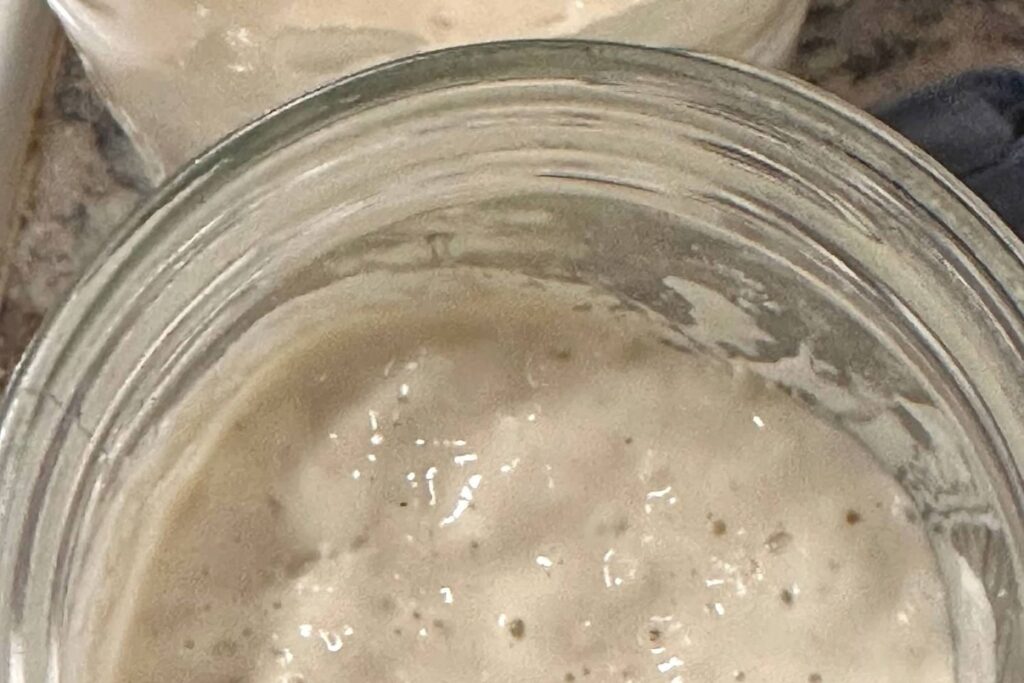
A sourdough starter is flour and water left to ferment until the wild yeast in it makes bread rise. From scratch it takes seven to fourteen days. From an established starter, you can be baking inside a week.
I keep mine on the counter in Ooltewah, Tennessee, at a steady 68–70°F, and I feed it once a day with bread flour. This is how I do it, what goes wrong, and how to get a jar of mine if you’d rather skip the waiting.
Key Takeaways
– From scratch takes 7–14 days. From an established starter, about a week.
– Bread flour and water is all you need. No pineapple juice, no yeast, no starter kit.
– At a steady 68–70°F, once a day is enough. A warmer kitchen needs more.
– Hooch, funny smells, and a stall around day 4 are all normal. Fuzzy mold is not.
– I sell active sourdough starter in Ooltewah, Tennessee. It’s the fastest way to skip the hard part.
What a Sourdough Starter Actually Is
A sourdough starter is a living culture of wild yeast and lactic acid bacteria living in a paste of flour and water. The yeast produces the gas that lifts your loaf. The bacteria produce the acids that give sourdough its flavor and its keeping quality.
Both come from the flour itself and from the air in your kitchen. You aren’t adding anything. You’re just giving what’s already there enough food and enough time to build up a population big enough to raise a loaf of bread.
That’s the whole thing. Flour, water, patience.
How to Make a Sourdough Starter From Scratch
What you need
- Bread flour. Plain bread flour is all I use — no whole wheat, no rye, nothing else in it. It has more protein than all-purpose and the starter behaves consistently on it, which matters more than any clever blend. The Perfect Loaf covers the hydration math in more depth than I will here. It has more protein and more of the wild yeast still attached than bleached all-purpose.
- Water. Tap water is fine unless yours is heavily chlorinated. If you’re unsure, leave a jug out overnight before you use it.
- A clean jar. Glass, roughly a quart. Don’t seal it tight — a jar that can’t vent will build pressure.
- A kitchen scale. This is the one thing people skip and then wonder why nothing works. Cups measure volume; fermentation cares about weight.
Day by day
- Day 1. Mix 50g bread flour with 50g water. Stir until there’s no dry flour left. Cover loosely. Leave it somewhere warm.
- Days 2–3. You may see a few bubbles. You may see nothing. Both are fine. Discard all but about 50g, then feed with 50g flour and 50g water.
- Day 4. Often it looks dead. It usually isn’t — this is the point where the early bacteria die back and the yeast hasn’t taken over yet. Keep feeding.
- Days 5–7. Real activity. It rises, it smells sour rather than sharp, it starts behaving predictably.
- Days 7–14. It should now roughly double within 4–8 hours of a feed. When it does that reliably three days running, it’s ready to bake with.
How to know it’s ready
Doubling on schedule is the real test. It should rise to about twice its height, hold there, then sink back.
The float test is the quick check: drop a spoonful into a glass of water. If it floats, there’s enough gas in it to raise bread. If it sinks, feed it and wait.
Don’t rush this. A starter that isn’t strong enough will make a dense, flat loaf and you’ll blame the recipe.
Feeding a Sourdough Starter: Temperature Runs Everything
Feeding sourdough starter is where most guides steer you wrong. They are written for one kitchen temperature, and yours probably is not it.
Mine sits at a steady 68–70°F, because the kitchen is air-conditioned year-round. That matters far more than the season does — my starter behaves the same in July as it does in January.
As a rough rule, fermentation speeds up markedly for every 15–20°F you go up. So a Tennessee kitchen that drifts to 80°F in August will run a starter close to twice as fast as mine, on the same flour, with the same feed. If yours isn’t held steady, the calendar will change your schedule even though nothing else has.
I feed once a day, and at 68–70°F that is comfortably enough. If your kitchen runs warmer you have two options: feed twice a day, or feed bigger. A larger ratio of fresh flour to old starter gives the culture more to eat, so it takes longer to exhaust — which is how people stretch a hot kitchen back to one feed a day.
| Kitchen temperature | What to expect | Practical schedule |
|---|---|---|
| 65–70°F | Slow, peaks in 10–12 hrs | Once a day, small feed |
| 71–76°F | Steady, peaks in 7–9 hrs | Once a day, larger feed |
| 77–82°F | Fast, peaks in 4–6 hrs | Once a day with a big feed, or twice a day |
| 83°F+ | Very fast, goes sour quickly | Twice a day, or move it somewhere cooler |
The signal to watch isn’t the clock — it’s the jar. Put a rubber band at the level of the starter after you feed it. If it doubles and is already sinking by the time you get back to it, it’s hungry sooner than you’re feeding it. Feed it more, or feed it twice.
In winter my kitchen drops and the whole thing slows down. Same starter, same flour, different pace. That’s not a problem to fix; it’s just what living things do.
What’s Going Wrong
It isn’t rising after 7 days
Almost always temperature. A sourdough starter in a 65°F kitchen in February is not dead, it’s cold. Move it somewhere warmer — on top of the fridge, in the oven with only the light on — and give it another few days.
Second most common cause is bleached all-purpose flour. Switch to bread flour and you’ll often see activity within two feeds. Some people stir in a spoonful of whole wheat or rye to kick a stubborn starter along — I don’t, but it does work, and it is a one-time thing rather than a change to what you feed it.
There’s liquid on top
That’s hooch — alcohol, a by-product of fermentation. It means the starter has eaten everything and is hungry. Pour it off if it’s dark, stir it in if it’s pale, and feed more often or feed more.
It smells like nail polish remover
Same message, more urgent. Acetone means it’s been hungry for a while. It isn’t ruined. Two or three good feeds will bring it back round.
Sour, tangy, beery, or a bit like yogurt are all normal. The smell changes with temperature and with how long it’s been since it ate.
When to throw it out
Almost nothing kills a starter. But fuzzy mold — pink, orange, black, or anything growing in a raised spot — means throw the whole thing out. Jar and all, or wash the jar in very hot soapy water. Don’t scrape mold off and carry on; the parts you can’t see have already spread through the paste.
Discoloration on the surface without fuzz is usually just oxidation. Fuzz is the line.
Keeping It Alive in the Fridge
If you bake once a week or less, the fridge is easier than daily feeding. King Arthur Baking has a good reference on long-term maintenance if you want a second opinion.
Feed the starter, leave it out for an hour or two so it starts working, then put it in the fridge. Once a week, take it out, discard down, feed it, and either bake or put it back.
Bringing it back: take it out the night before you want to bake and feed it once at room temperature. At 68–70°F one overnight feed is usually enough. In a colder house, give it two feeds over 24 hours.
A sourdough starter that’s been in the fridge for a month will look gray and sad and smell strongly of alcohol. It’s almost certainly fine. Feed it twice and see.
Naming Your Starter
Nearly everyone names theirs, and it isn’t as silly as it sounds — you will talk about this thing daily for years, and “did you feed it” is easier when it has a name. Most land on a yeast pun, a grandmother, or a joke about coming back from the dead.
Whatever you choose, write the name and the date you started it on the jar. Not for sentiment — when you have two jars going and one is a rye experiment, you will forget which is which.
If you want ideas, I’ve put together 175 sourdough starter names, sorted by the kind of person naming them.
Sourdough Starter Near Me: Where to Get One Around Ooltewah
Here’s the honest shortcut: almost nobody’s starter came from scratch. Most bakers were given theirs. Mine came from someone else’s kitchen, and the one you get from me will carry on the same way.
An established starter skips the fragile part entirely. No dead-looking day 4, no wondering whether the smell is right. You feed it once or twice, it doubles, you bake.
I sell active sourdough starter to anyone local. It comes in a jar, already awake and feeding, with a note on what flour it’s used to and how I keep it. It is made with bread flour, so it contains wheat and gluten. If you’re in Ooltewah, you can collect it. I also deliver around the immediate area, and if you’re further out — Chattanooga or Cleveland — ask and we’ll work something out.
Email me and say when suits.
If you’d rather taste the result before committing to keeping something alive, here’s the sourdough I bake each week and how ordering works.
And if you want neither the jar nor the commitment, you can just know when the bread comes out — a note on bake days, no more than a couple of times a month.
Questions People Actually Ask
How long does it take to make a sourdough starter?
Seven to fourteen days from scratch. About a week from an established starter to your first confident loaf.
Can I use all-purpose flour?
Yes, but it’s slower, and bleached all-purpose especially so. I use plain bread flour and nothing else. If a starter is being stubborn, a single spoonful of whole wheat or rye will often wake it up — but you don’t need it as a regular feed.
Do I have to throw away discard every time?
While you’re building it, yes — otherwise the jar grows enormous and the culture never gets a strong enough feed. Once it’s established you can keep less and feed more.
How do I feed sourdough starter from the fridge?
Take it out, discard down to a small amount, feed it, and leave it at room temperature until it doubles. One overnight feed usually does it; two if your kitchen is cold.
Can I kill it by missing a day?
Very unlikely. Starters survive weeks of neglect in the fridge. They get sour and sluggish, not dead.
Is it cheaper to buy a starter kit?
A kit is flour, water, and a jar you probably own, plus packaging. You need bread flour, water, and a scale. That’s it.
Getting Started
A sourdough starter is the least complicated part of sourdough baking. Flour, water, a warm spot, and enough patience to leave it alone on day four when it looks like nothing is happening.
The two things that matter most: weigh things, and watch the jar rather than the clock. Temperature runs the whole process, and a kitchen at 80°F behaves nothing like one at 68°F.
If the waiting isn’t appealing, skip it. I keep a starter going year-round and I’m happy to share it — send me a message and I’ll set a jar aside. You can also read a bit about how Bronnies started, which was, as it happens, one loaf for one person.
Written by Bronwyn, Bronnies. Last updated August 3, 2026.